Emotional Regulation Loops
Patterns that begin as coping, soothing, or settling and slowly become part of the rhythm.
Future galleryThe center is no longer a door. It is a mirror. The visitor sees the exhibits around the room, but the final exhibit is the nervous system that recognizes itself.
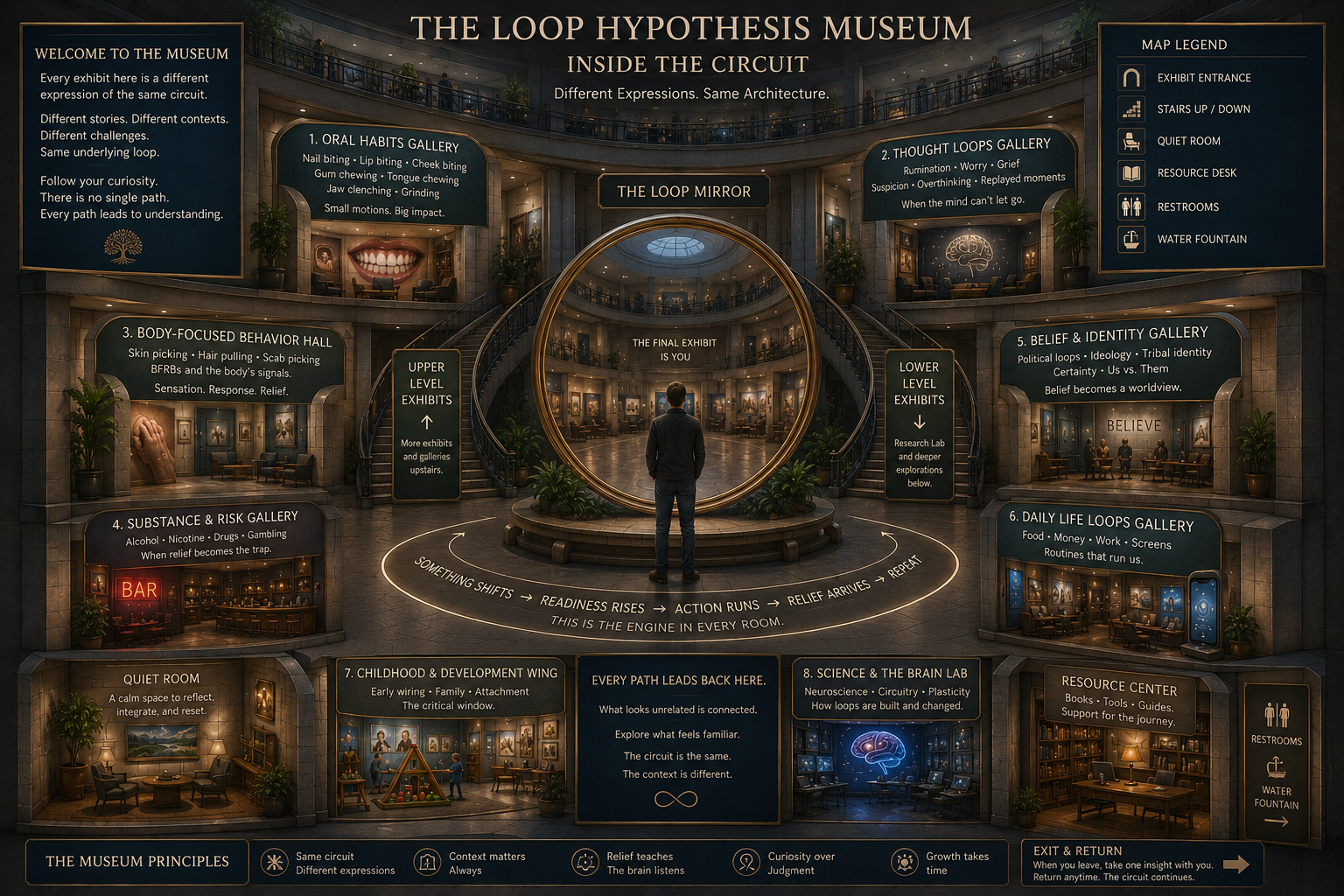
The mirror works because it avoids making the museum about any single condition or habit. It says: these rooms are not curiosities about other people. They are patterns a human nervous system can recognize in itself.
The mirror also solves the doorway problem. A visitor does not have to believe that food, checking, belief, scrolling, oral habits, and hoarding are the same. They only have to enter the atrium and notice that each exhibit leads back to the same loop structure.
The atrium is the Museum’s open hallway. Explore the rooms in any order, or rejoin one of the three guided entrances: recognition, mechanism, or the Reading Room.
This museum is not simply a collection of behaviors. It is designed to help you see the hidden mechanism: what starts a loop, what keeps it running, what brings relief or completion, and what changes its volume.
The rooms may look unrelated. The lesson underneath them is the same: once a loop becomes traceable, the right kind of leverage becomes easier to recognize.
Start with a habit, urge, thought, room, or ritual that already feels familiar. Recognition comes before explanation.
Find your doorway →Enter the Loop Engine and follow the guided five-part mechanism path from pattern to circuit volume and sensory clues.
Follow the mechanism →Move into the manuscript for the fuller argument, chapter pathways, personal story, and deeper context behind the museum.
Open the Reading Room →You are in open exploration here. Wander as long as you like. These three entrances are always available when you want a clear route again.
The museum is organized by recognition, not diagnosis. Nine galleries are open. One remains visibly under construction.
These rooms were chosen because each one makes a different part of the loop visible. One reveals high-resolution sensation. Another shows relief, uncertainty, prediction, repetition, identity, or the absence of a stopping cue. Together, they form a teaching map of the hidden mechanism beneath many different behaviors.
You may recognize yourself in one room, several rooms, or none of them exactly. The goal is not to find your label. It is to learn how to see the loop.
Chewing, biting, grinding, humming, and loops that live behind closed lips.
Open gallerySkin, hair, nails, lips, cheeks, and the body’s high-resolution signals.
Open galleryNovelty, fullness, comfort, repetition, and environments without endings.
Open galleryAlcohol, nicotine, gambling, relief, consequence, and return.
Open galleryRumination, worry, grief, grievance, suspicion, and thoughts that circle.
Open galleryCertainty, identity, belonging, sacred frames, and defended realities.
Open galleryEndless scroll, novelty, interruption, and attention that never gets an ending.
Open galleryLocks, reassurance, certainty, and the question that asks again.
Open galleryAcquisition, non-discard, avoidance, memory, and the house made of yes.
Open galleryPatterns that begin as coping, soothing, or settling and slowly become part of the rhythm.
Future gallery