The target changes. The loop can rhyme.
Something is noticed. A precise movement follows. The sensation changes. For a moment, the system settles. Then the route becomes easier to run again.
Skin, hair, nails, lips, and hands can become the surface where a nervous system searches for smoothness, release, certainty, or completion.
The surface changes. The nervous-system job often does not. This room brings four finished exhibits together without treating every repeated movement as a disorder.
Something is noticed. A precise movement follows. The sensation changes. For a moment, the system settles. Then the route becomes easier to run again.
Body-focused repetitive behaviors include patterns involving skin, hair, nails, lips, cheeks, and related body sites. Some are mild and occasional. Excoriation disorder and trichotillomania are recognized clinical disorders when the behavior causes damage, distress, or impairment.
This room is for recognition and understanding. It is not a self-diagnosis tool.
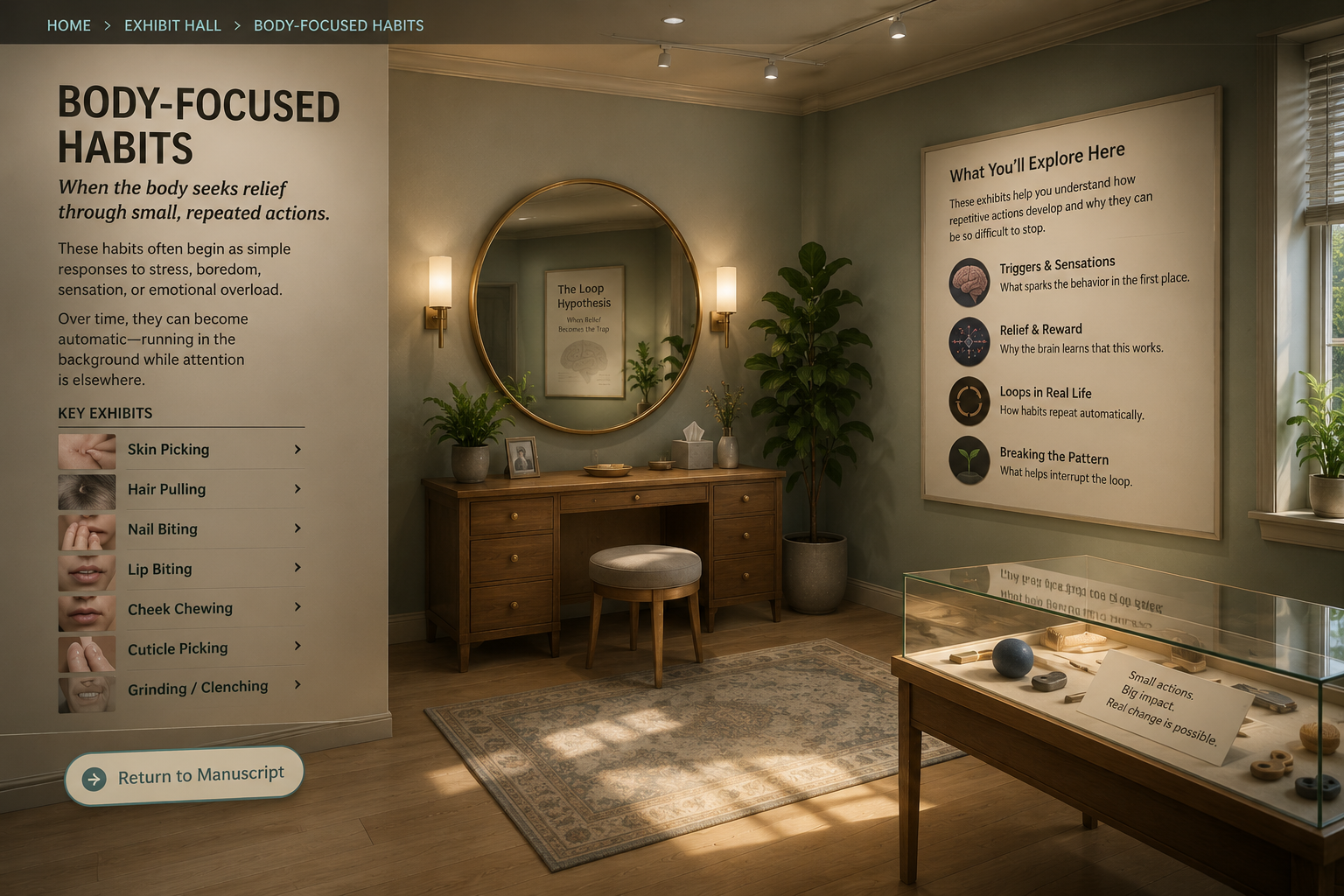
Begin with the featured recognition doorway, or enter through any of the other completed exhibits.
The spot that becomes the whole room. A rough patch, scab, pore, or peeling edge becomes difficult to leave unfinished.
Open exhibitThe strand that feels different. Fingers sort, test texture, select one hair, and find release in the pull.
Open exhibitThe other completed exhibits explore the same body-focused family through hair, nails, lips, and cheeks.
This doorway connects to the manuscript pathways on nail biting, skin picking, hair pulling, cuticles, mouth overlap, edge signals, and hidden hands.
Ready to look beneath the behavior? Begin with the shared circuit, then follow the five-part mechanism path without losing your place.