Tools & Experiments
A practical lab for small experiments. Some may apply across many loops. Others belong to specific rooms. Nothing here is a cure or prescription — it is a way to notice whether a signal changes.
Start with the shelf that matches your loop.
Not every tool belongs to every visitor. A retainer experiment belongs with oral habits. A delay experiment may belong with smoking, drinking, scrolling, or return loops. Start broad, then choose the room that fits.
These are experiments, not treatments. Notice what happens, rate the signal, and stop anything that feels uncomfortable or unsafe.
Useful across many loop types
90-Second Loop Check
Rate the urge, try a brief competing-signal sequence, then rate again.
Look Into the Distance
A soft visual reset for moments when attention has narrowed around the loop.
Heel–Toe–Heel
A simple rhythm interrupt for waiting, sitting, standing, or transition moments.
Volume Rating
Give the urge a 0–10 number before and after an experiment.
Choose the family that brought you here.
Oral Habits
Coming soon: tongue parking spot, retainer/oral gating, sour taste + gentle jaw pressure.
Body-Focused / Edge Loops
Coming soon: texture anchor, cover-and-rate, smooth-edge substitute.
Smoking / Drinking / Return Loops
Coming soon: delay-and-rate, change the ritual path, first-sip / first-cigarette tracking.
Thought / Belief Loops
Coming soon: name the loop, write the repeating question, ask whether the thought is moving or circling.
Hoarding / Saving Loops
Coming soon: one-object experiment, keep/toss/hold, 24-hour maybe box.
Attention / Digital Loops
Coming soon: one-screen pause, distance gaze reset, notification friction test.
Why “sensory tricks” still matter
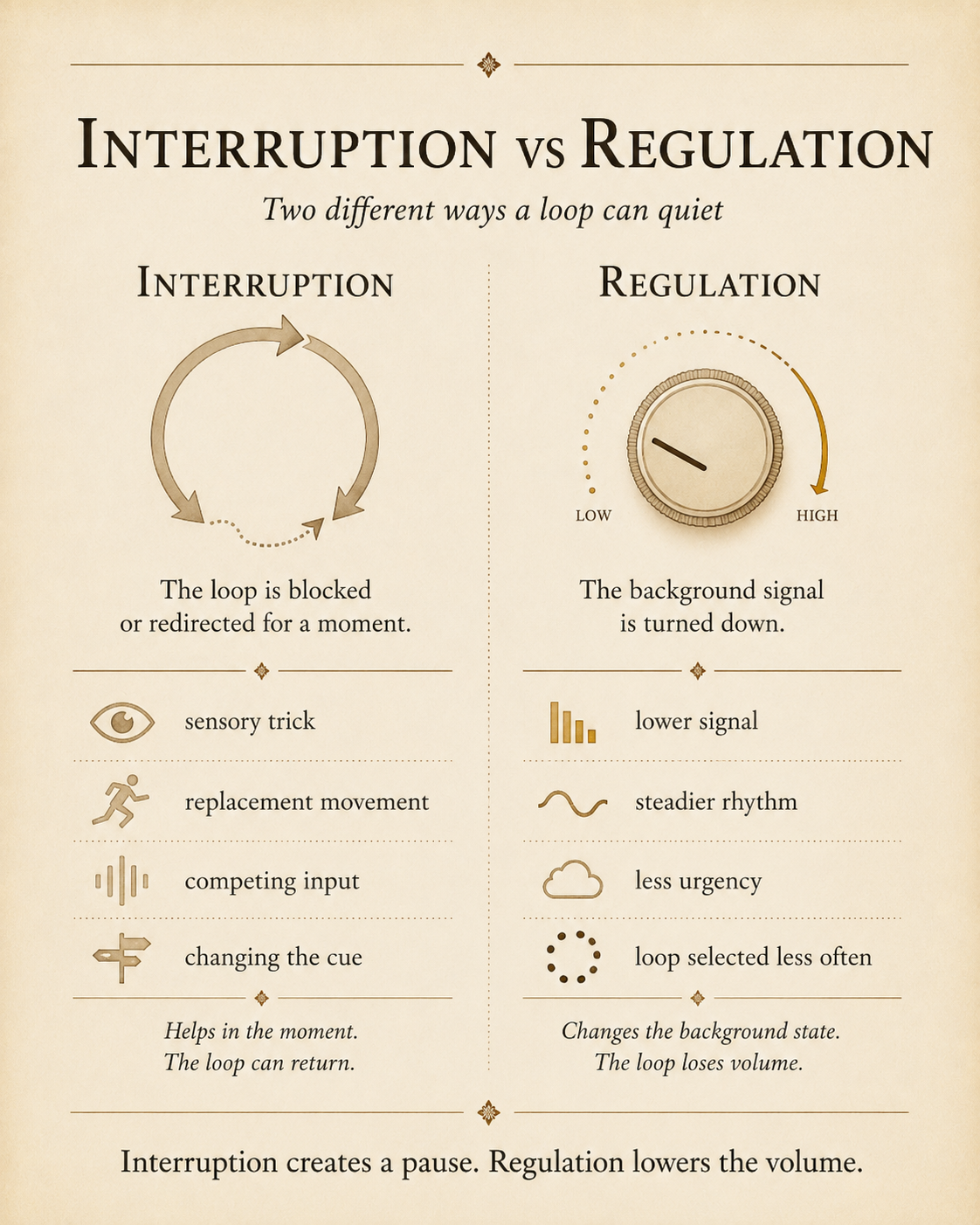
Some of these tools are based on what neurologists call sensory tricks, or geste antagoniste — small counter-signals that can briefly change a movement, urge, or state. On this site, we usually call them experiments because that is the safer word: try carefully, observe honestly, and do not overpromise.
Experiments are clues, not the main path.
Return to the mechanism sequence to keep your place, or continue to Sensory Tricks to see why small inputs can matter.