Emotional Regulation Loops
Patterns that begin as coping, soothing, or settling—and slowly become part of the rhythm.
Future gallery — currently in development
What if the habits, urges, thoughts, and behaviors that keep returning are not random — but loops your nervous system learned to run?
A living map of the repeating patterns that move through the body, mind, and nervous system — often before choice has a chance to arrive.
Choose a guided entry: begin with recognition, follow the mechanism step by step, or enter through the book. If you would rather wander, the Museum remains open for free exploration.
Start with a habit, urge, thought, room, or ritual that already feels familiar. Recognition comes before explanation.
Find your doorway →Enter the Loop Engine and follow the guided five-part mechanism path from pattern to circuit volume and sensory clues.
Follow the mechanism →Move into the manuscript for the fuller argument, chapter pathways, personal story, and deeper context behind the museum.
Open the Reading Room →Guided or open: Routes one, two, and three give you a clear way forward. Explore the Museum is the open route — wander the rooms in any order and return to a guided path whenever you want.
The house is quiet after dinner. The dishes are done. A television murmurs from the next room. Someone is half-reading on the couch. Someone else checks a phone they already checked thirty seconds ago.
A foot rocks against the floor. A jaw tightens in the silence. Fingers rub the same place on the edge of a chair. No one is upset. No one is doing anything dramatic. And yet the room is full of small repetitions.
This is where loops are easiest to miss. They do not always arrive as crises. Sometimes they arrive as the body keeping time.
Mechanism: A loop is a small sequence the nervous system repeats because it once helped the system settle.
Visitors do not have to begin with a diagnosis. They can choose the doorway that feels familiar, then move toward the specific habit, chapter, or mechanism underneath.
These rooms were chosen because each one makes a different part of the loop visible. One reveals high-resolution sensation. Another shows relief, uncertainty, prediction, repetition, identity, or the absence of a stopping cue. Together, they form a teaching map of the hidden mechanism beneath many different behaviors.
You may recognize yourself in one room, several rooms, or none of them exactly. The goal is not to find your label. It is to learn how to see the loop.
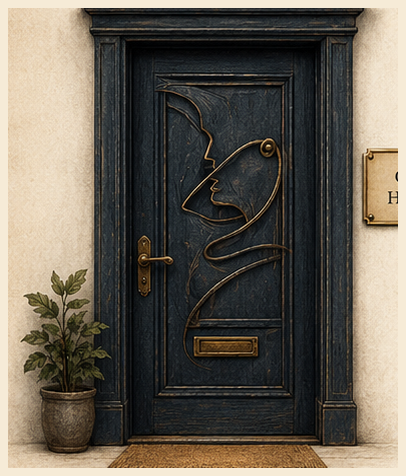
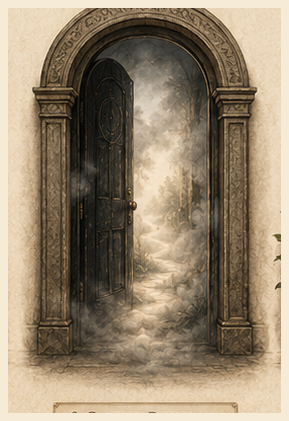
Loops that live around the mouth—chewing, biting, grinding, or other hard-to-explain oral patterns.
Enter the room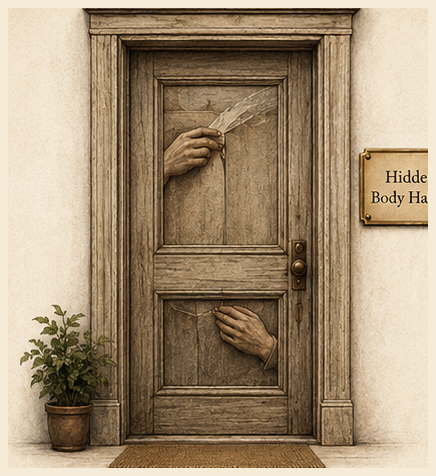
Repetitive habits directed at the body, often automatic, soothing, or hard to stop once they begin.
Step through
Eating patterns that feel less like hunger and more like a return, a pull, or a ritual.
Step through
The pull back toward relief, stimulation, risk, reward, or one more return.
Step through
Thoughts that circle back, replay themselves, or stay active long after they stop being useful.
Step through
Stories the mind repeats until they start to feel like fact.
Step through
The repeat-pull of screens, updates, novelty, and the urge to check one more time.
Step throughPatterns that begin as coping, soothing, or settling—and slowly become part of the rhythm.
Future gallery — currently in development
The need to verify, adjust, repeat, or make something feel complete before moving on.
Step through
Holding on to things, possibilities, or decisions because letting go feels harder than keeping.
Step throughLoops that live around the mouth—chewing, biting, grinding, or other hard-to-explain oral patterns.
Repetitive habits directed at the body, often automatic, soothing, or hard to stop once they begin.
Eating patterns that feel less like hunger and more like a return, a pull, or a ritual.
The pull back toward relief, stimulation, risk, reward, or one more return.
Thoughts that circle back, replay themselves, or stay active long after they stop being useful.
Stories the mind repeats until they start to feel like fact.
The repeat-pull of screens, updates, novelty, and the urge to check one more time.
Future gallery — currently in development.
The need to verify, adjust, repeat, or make something feel complete before moving on.
Holding on to things, possibilities, or decisions because letting go feels harder than keeping.
The manuscript follows one carefully built path through recognition, learning, body loops, relief, meaning, sensory signals, and chemistry. Open the book to explore its seven Parts and public chapter previews.
Some visitors enter through a behavior. Others enter through the mechanism. These science portals are larger doorways into how loops form, why they get louder, what keeps them running, and what may help turn the signal down.
The basic pattern behind repeated behavior: signal, action, relief, and reset.
Enter the engineRelief teaches repetition. What worked once can become faster, quieter, and more automatic.
See why loops repeatGlutamate helps the system go. GABA helps it settle. Dopamine marks what worked.
Enter the chemistryWhat turns the signal up — and what may help turn it down?
Enter the control room
You probably recognized something here.
A loop that sounds familiar. A family it belongs to. A feeling you’ve had but never had language for.
That recognition is the beginning.
The manuscript goes deeper — into the circuit underneath, the signals behind it, and what it may mean to turn the volume down, or sometimes feel the loop go quiet.
New chapters, diagrams, doorway pages, and discoveries land here first.
You can also write directly: hello@theloophypothesis.com
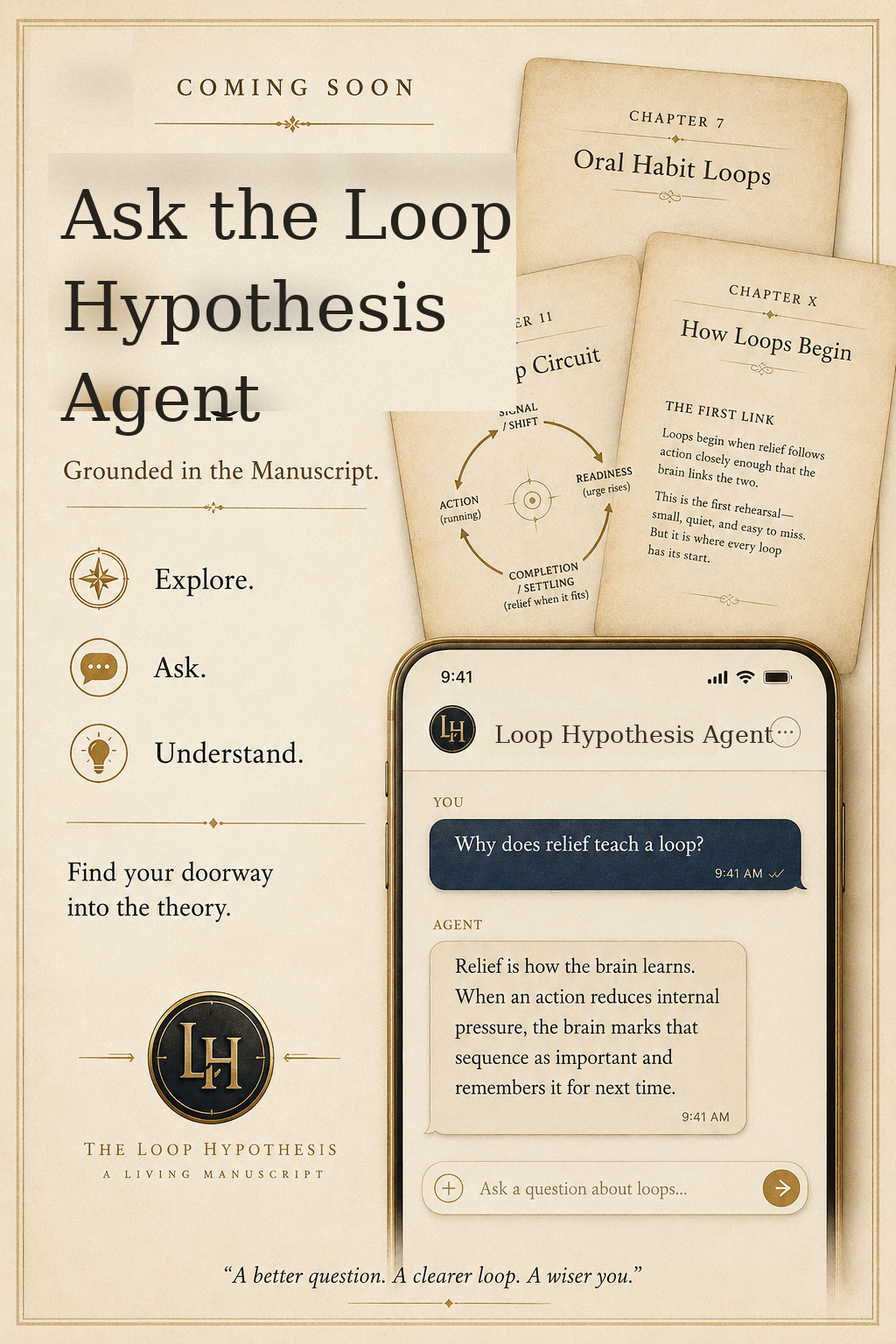
A guided companion grounded in the manuscript: by chapter, loop family, mechanism, or personal doorway.
Educational only. It will not diagnose, treat, or replace medical or mental health care.