Understanding & Expectation
Meaning changes how a signal is interpreted. Expectation changes what the nervous system predicts will happen next.
Can modify all three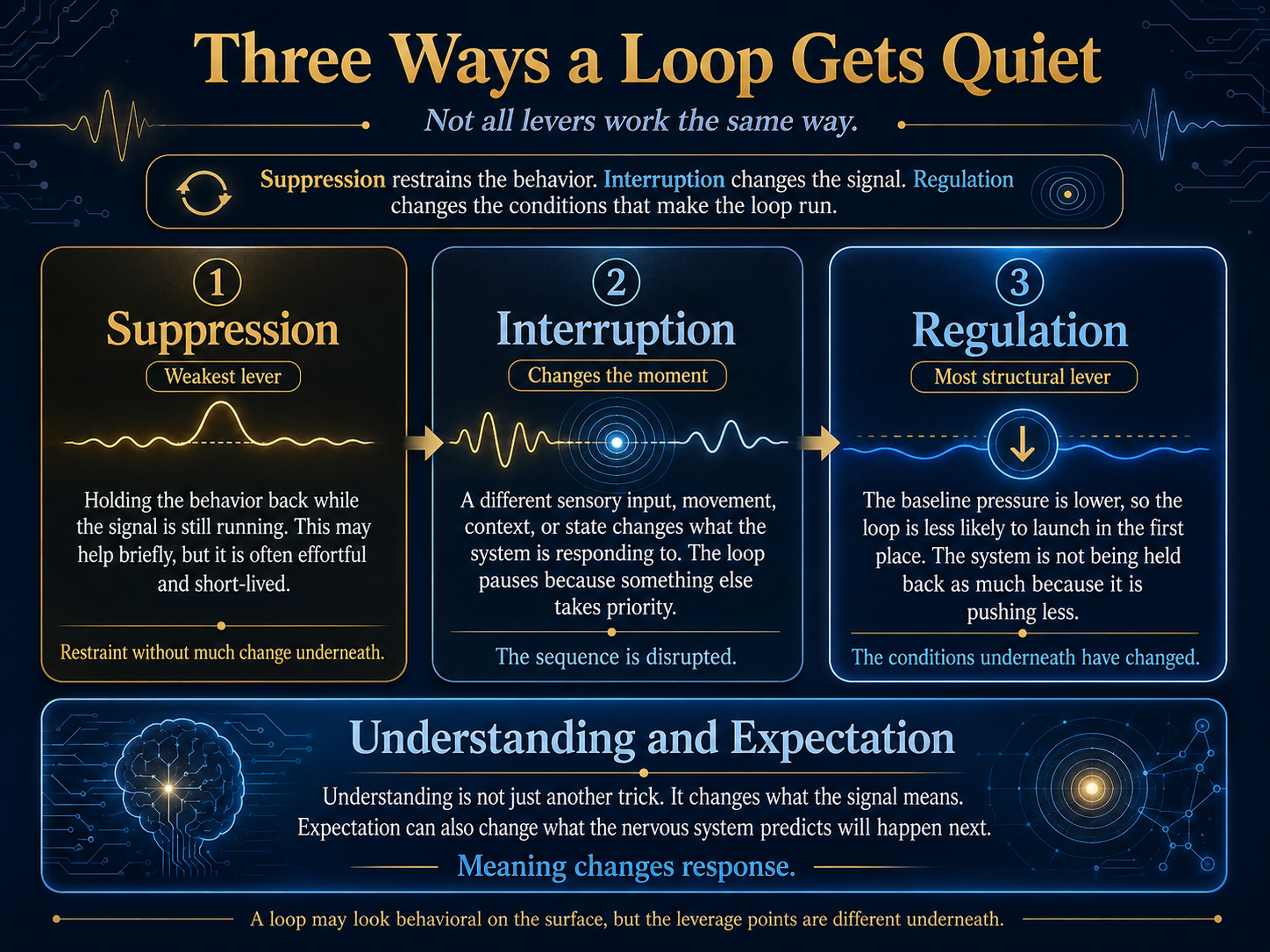
A behavior stopping does not necessarily tell us what changed underneath. That distinction matters, because the lever that held a loop back for thirty seconds is not the same lever that made it less likely to start.
Suppression is the most familiar strategy: resist the behavior. It can matter, especially when a person has time to notice an urge and choose differently. But in fast, automatic motor loops, suppression may be the weakest lever because the underlying signal is still running. The behavior is being restrained; the system has not necessarily settled.
Interruption changes the moment. A shift in posture, room, attention, movement, or sensory input can make the nervous system organize around something else. Sometimes the urge fades. Sometimes it simply pauses. Either way, the interruption tells us something important: the loop is responsive to signal.
Regulation changes the starting conditions. The circuit is less ready to launch, the cue carries less force, or the system settles more completely. Sleep, physiology, learning, context, and chemistry can all influence this layer. When chemistry is part of the story, N-acetylcysteine (NAC) is one possible glutamate-modulating lever for some people—not a cure, and not the only route to regulation.
Understanding and expectation cut across all three. They are not simply a fourth step after regulation. Understanding can change the meaning of a signal: from failure, danger, or command to something recognizable and traceable. Expectation can change what the nervous system predicts will happen next. Meaning does not replace circuitry. It enters the same system.
The three ways describe what changed. These five inputs describe what may have changed it. They are not five more kinds of quiet.
Meaning changes how a signal is interpreted. Expectation changes what the nervous system predicts will happen next.
Can modify all threeTouch, pressure, posture, temperature, texture, rhythm, or another competing signal can redirect what the system is listening to.
Often interruptionRooms, objects, people, screens, routines, and cues can either help launch a loop or make it less likely to begin.
Interruption or regulationMorning, fatigue, transitions, focus, stress, sleep, and other state changes can alter when a loop is easiest to trigger.
Changes launch conditionsChemical state can change background gain. For some people, that may make a loop quieter, less urgent, or less likely to be selected.
Often regulationYou now have both layers: how a loop gets quiet and what kinds of input can influence its volume. Sensory Tricks is one of the clearest examples of an interruption pathway.
This page sits underneath it: first the three forms of quiet, then the five kinds of input that can influence volume. The hierarchy is now one map, not two competing lists.