The Door Was Already Locked
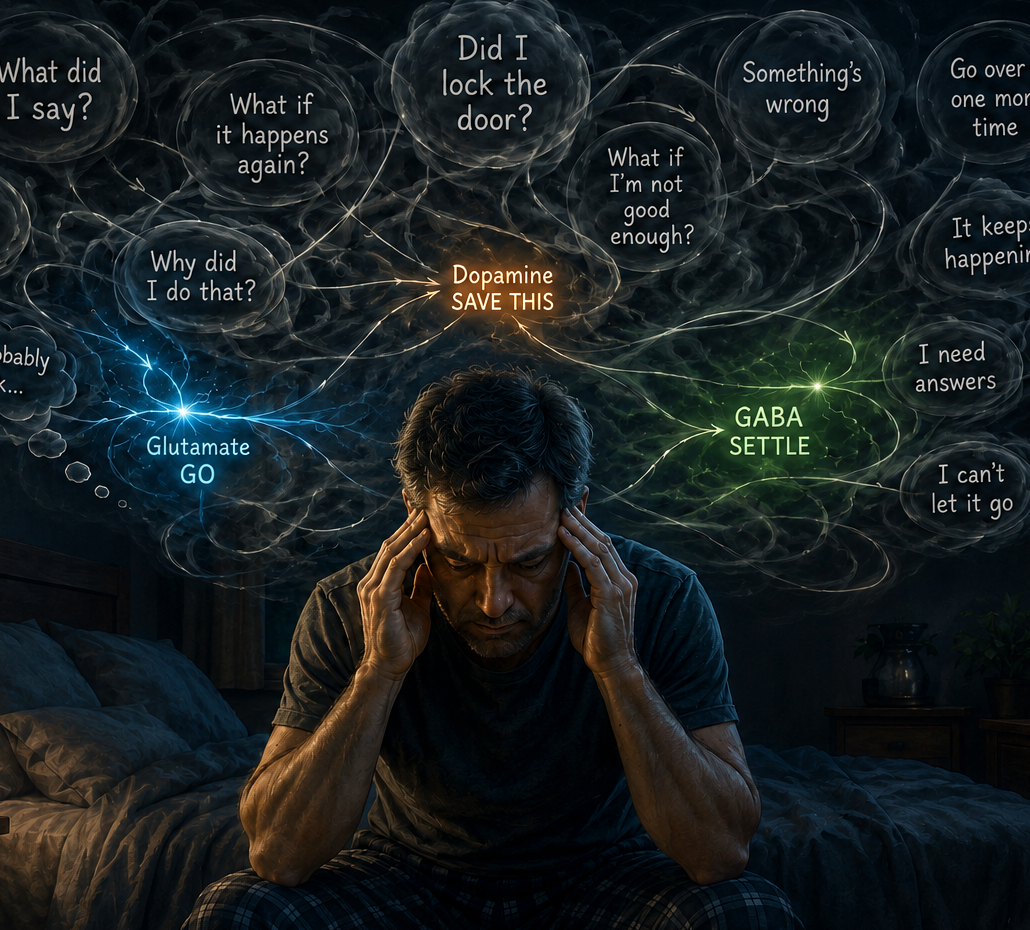
He checks the lock. He feels it turn. He even says it out loud: locked.
Then he walks away and something loosens. Not the lock. The certainty.
Before he reaches the car, the question is back. Did I really check it? The body tightens as if an unfinished task were still waiting. So he goes back.
The exhausting part is not that the first check failed. It is that the relief from checking failed to last.
The problem is not care. The problem is that reassurance will not stick.
This exhibit is not about being careless versus responsible. Most checking loops begin in ordinary care: locking the door, turning off the stove, sending the right message, making sure nothing important was missed. The loop begins when the nervous system stops treating the first check as enough.
Ordinary caution
You check, the task closes, and your attention moves on. The action leaves a memory strong enough to settle the question.
Looped checking
You check, feel brief relief, and then doubt reappears. The system does not trust the calm, so it asks for another round.
How the checking loop resets itself.
That is the trap. The check reduces distress for a moment, so the brain learns that checking matters. But because the relief is brief, the action is rehearsed again instead of completed.
Relief can train repetition without creating confidence.
The action works too well
Checking lowers tension. That makes it attractive. The nervous system starts reaching for the check whenever doubt spikes.
The memory gets weaker
Repeated checking can blur the memory of the first real check. Instead of strengthening certainty, the repeated action can make the moment feel less distinct.
The question becomes the cue
Once the sequence is learned, the thought itself—Did I?—becomes enough to trigger another round.
That is why checking loops can feel so personal and so irrational at the same time. The person knows the door was probably locked. The problem is that knowing no longer produces the bodily feeling of done.
And without that feeling, the loop keeps recruiting action.
Locks are only one doorway into the same mechanism.
One person goes back to the front door. Another re-reads a text message. Another checks a symptom online. Another asks for reassurance. Another reviews a conversation late into the night. The objects change, but the sequence stays familiar: uncertainty, action, short relief, return.
The loop is not limited to physical checking. It can be cognitive, relational, digital, or bodily. What unifies the family is not the object but the unstable feeling of completion.
The action promises safety when the feeling says something is unresolved.
Checking and control rituals often appear when uncertainty feels unusually hard to tolerate. The action offers a small promise: if I run this sequence one more time, maybe the danger will finally settle.
That promise makes sense from inside the loop. It is trying to solve a feeling, not merely verify a fact. The verification may already exist. What is missing is the internal landing of enough.
Recovery starts when the system can survive uncertainty without another pass.
The humane reframe is simple: the goal is not to stop caring. It is to stop asking checking to produce a level of certainty that no repetition can deliver. What helps is not argument alone, but learning to notice the surge, delay the ritual, and let the feeling crest without obeying it immediately.
Recognition
Name the sequence when it starts: uncertainty, urge, check, relief, return. Seeing the machinery lowers some of its invisibility.
Tolerance
The loop loosens when the body learns that doubt can be present without requiring instant reassurance. That is where space begins.
Certainty is not the same thing as safety.
Checking loops keep chasing a feeling of complete certainty. But life rarely offers that standard. Doors get locked without perfect feelings. Messages get sent without total confidence. People move on while some small uncertainty remains.
The loop begins to weaken when the nervous system can let that be true.
The first check can become enough again.
The aim is not recklessness. It is a return to ordinary closure: a completed action, a remembered moment, and a body that does not need to reopen the same question all night.