Endless Scroll
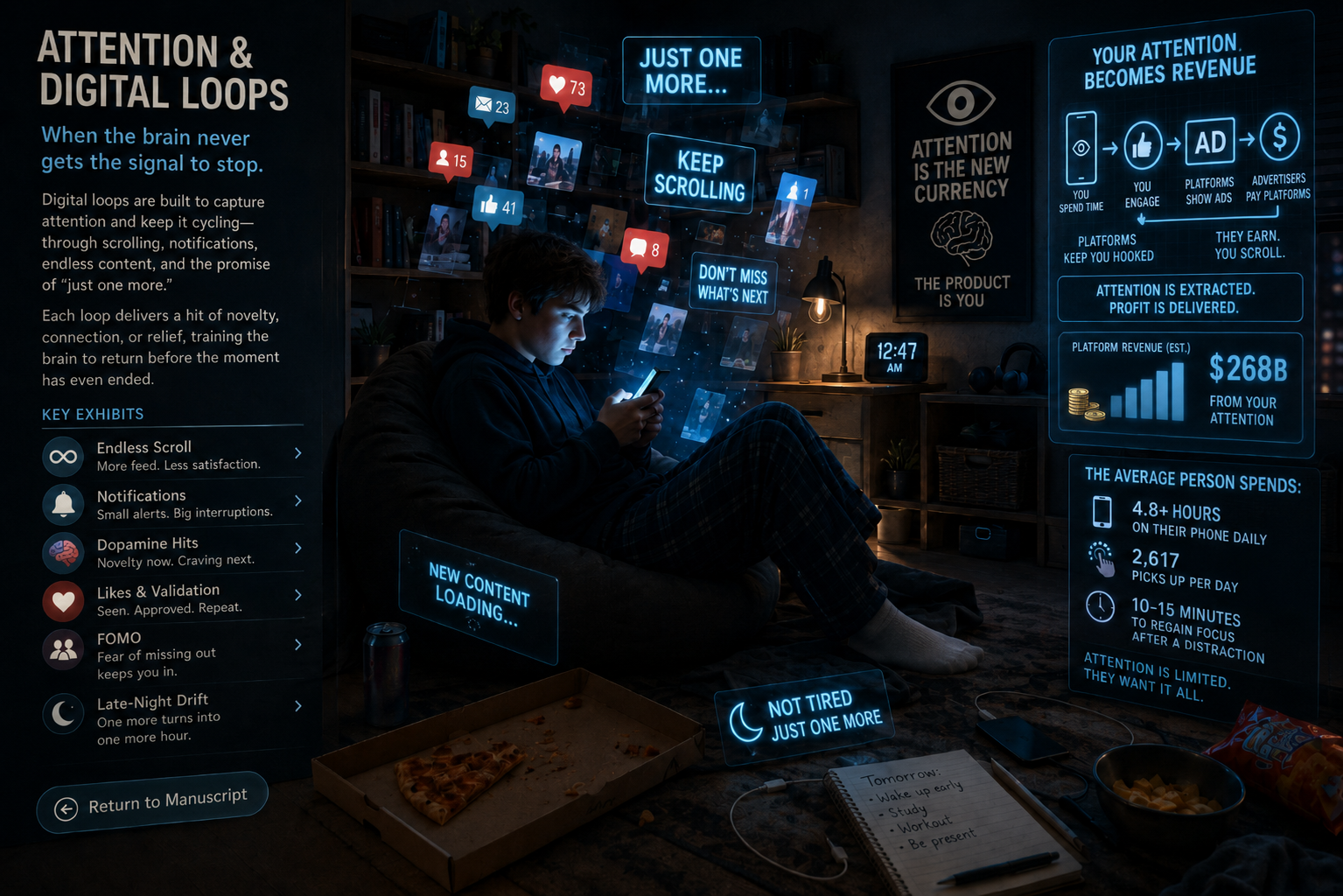
He picks up the phone for one reason.
To check the time. To answer one message. To look up one thing.
But the hand is already inside a room built without endings. A notification pulls the eye. A headline opens a feed. A video suggests the next one before the first one has even finished landing.
Five minutes later, he is no longer doing the thing he meant to do. He is following the next cue, and then the next one after that.
The unsettling shift is not that the person lost character. It is that the environment never gave the nervous system a clean place to stop.
The problem is not just self-control. The environment is designed to prevent closure.
This exhibit is not an anti-technology sermon. Phones are useful. Feeds can be entertaining. Alerts can matter. The question is narrower and more practical: what happens when an environment is built to keep the next cue visible, the next reward possible, and the stopping point unclear?
Ordinary use
A tool helps you do something, then the interaction ends. The task closes, attention releases, and the body settles.
Looped use
The task opens into a stream. Novelty stays available. The thumb keeps moving because each small cue promises that the next one might finally feel like enough.
How the scroll keeps itself alive.
The loop does not depend on one giant reward. It runs on many small maybe's. A post, a message, a like, a surprise, a tiny resolution, a social signal. The nervous system learns that one more movement might settle the feeling—or at least replace it with another one.
Digital rooms are especially good at keeping the circuit open.
No natural ending
A book has a page count. A conversation can end. A television episode resolves. A feed keeps loading. Without a visible finish line, the body has less help deciding that now is enough.
Variable reward
Most items in the feed are forgettable. That is part of the power. The next one might be funny, useful, intimate, alarming, flattering, or important. Unpredictable reward keeps the system leaning forward.
Interruption everywhere
Digital loops do not wait for a chosen moment. Badges, vibrations, red dots, previews, and recommendation bars keep throwing hooks into the day, turning external prompts into internal readiness.
That is why digital loops can feel strangely unsatisfying. They are not always delivering a strong ending. Often they are preventing one. A person may spend twenty minutes on a phone and still feel underfed, unsettled, or mentally scattered afterward.
The moment kept moving, but it never really closed.
When one more look is the product.
In many digital environments, the goal is not simply to help you find a thing and leave. The goal is to keep you engaged. More time means more ads, more data, more learned preferences, more opportunities to reinsert the next cue.
This is where the room becomes bigger than one person's habits. The architecture itself is pulling in the same direction as the loop. The environment benefits when stopping becomes less likely.
That does not mean every designer is malicious. It means incentives matter. A system built to reward continued engagement will usually become skilled at producing it.
The brain is learning from motion, surprise, and relief.
You do not need complicated neuroscience to understand the outline. Glutamate helps the system go. Dopamine tags what seemed to work or what might matter. GABA helps the system settle again. In a scrolling environment, the first two are constantly recruited while the third is repeatedly delayed.
The result is not a moral failure. It is a nervous system being trained by an environment full of small invitations to continue.
The nervous system needs endings it can feel.
Most people already know the shallow advice: just use your phone less. But looped environments usually require more than moral instruction. They respond better when the room itself changes shape.
Interruption
Put distance between body and cue. Turn the phone face down. Remove badges. Leave the room. Create a stopping point the feed will not give you on its own.
Regulation
Notice when scrolling is being asked to solve something: boredom, loneliness, pressure, transition, exhaustion, avoidance, not-rightness. The pull quiets more deeply when the underlying state is less hungry for an exit.
The humane point is not perfection. It is legibility. Once the room becomes visible as a looped environment, stopping no longer has to feel like a referendum on character.
A useful screen does not have to become an endless hallway.
Technology is not the enemy here. The loop is. A phone can remain a tool. A conversation can remain a conversation. A search can end when the answer is found. What changes things is whether the environment helps the nervous system close the moment—or keeps teaching it to continue.
That small distinction creates a surprising amount of freedom.
The room can become a tool again when it learns how to close.
The goal is not to swear off digital life. It is to recognize the difference between using a device and being carried by an environment that never says enough.